
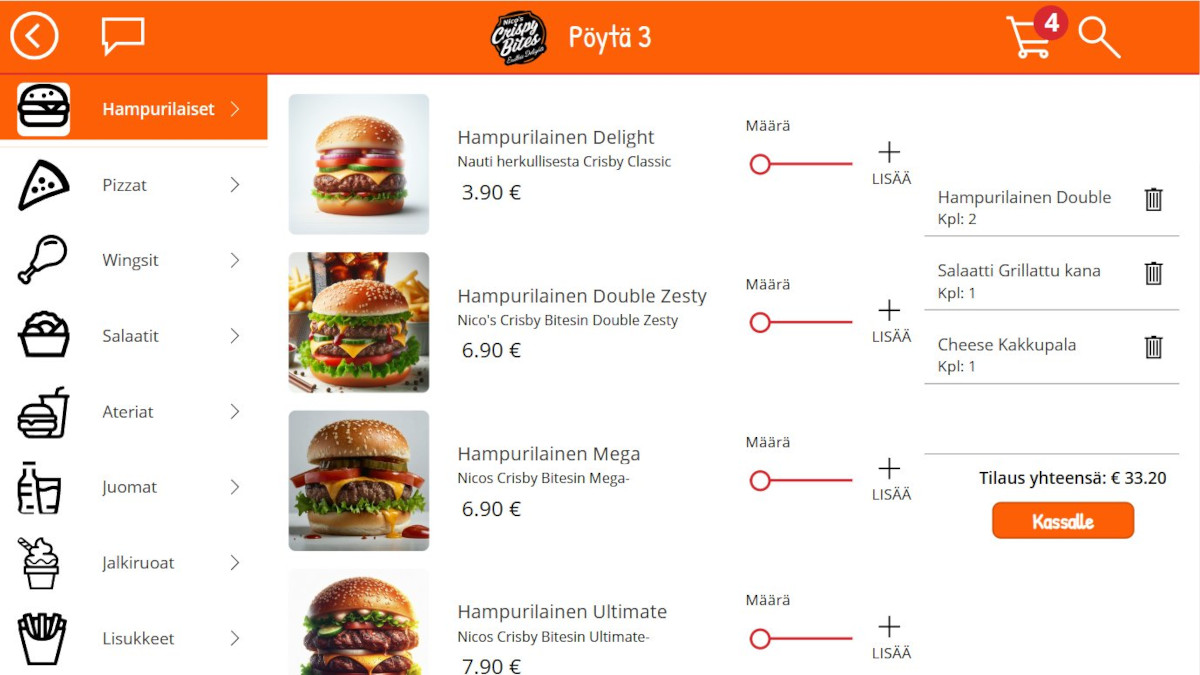

This practice project was an application that I made as a demonstration work for the Taitotalo Low-Code System Developer training program. The project involved implementing a restaurant ordering system for a fictional fast-food restaurant. The purpose of the project was to create a system that serves as a channel between customers and the restaurant staff. The goal was to simulate a system as realistically as possible, ensuring it could be used in a real-world environment.
For the implementation, I primarily used Microsoft Power Platform applications, such as Power Apps, Power Automate, and SharePoint. The project was carried out with a strong focus on functionality and practicality, applying fundamental software concepts learned during my studies. A significant portion of the project time was spent learning new functionalities from various sources. Additionally, image editing and modeling software, as well as AI-based generation tools, were used in the project.
The objective of the implementation was to develop a system that would transmit customer orders directly from restaurant tables to the staff. The system is designed to first send orders to the kitchen for processing and then notify the appropriate party when the orders are ready. Customer terminals can only be used to place orders, the kitchen interface allows acknowledging orders as received for processing or as completed, and the cash register interface can only confirm that an order has been delivered.
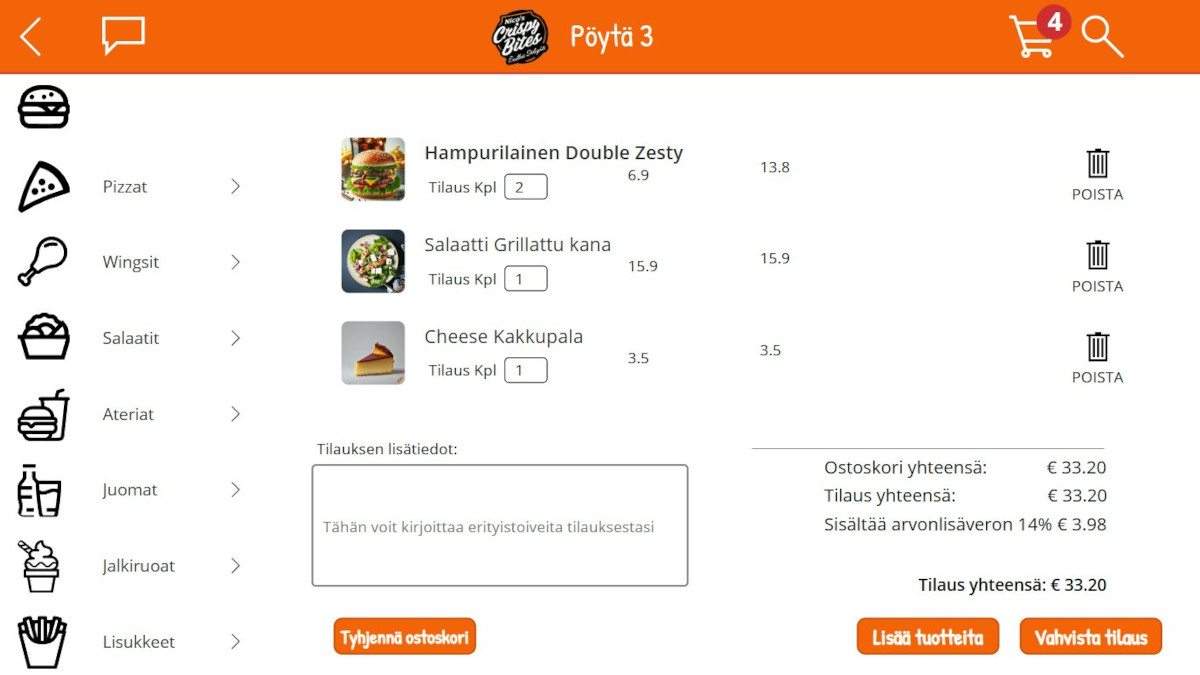
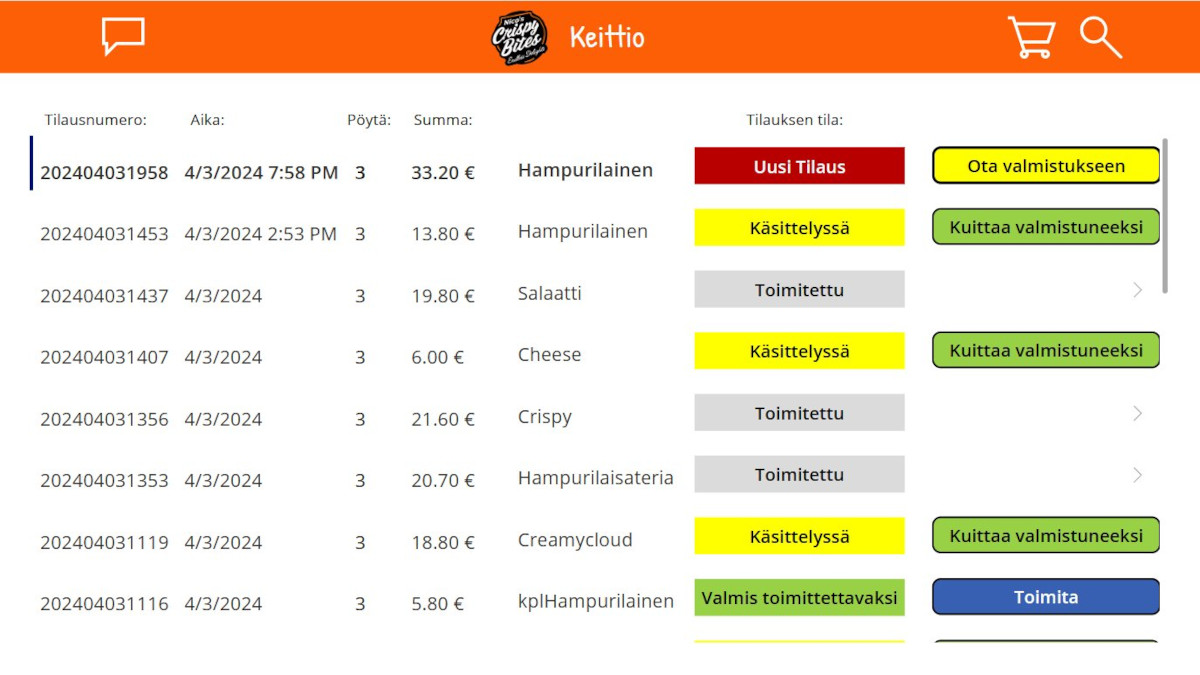
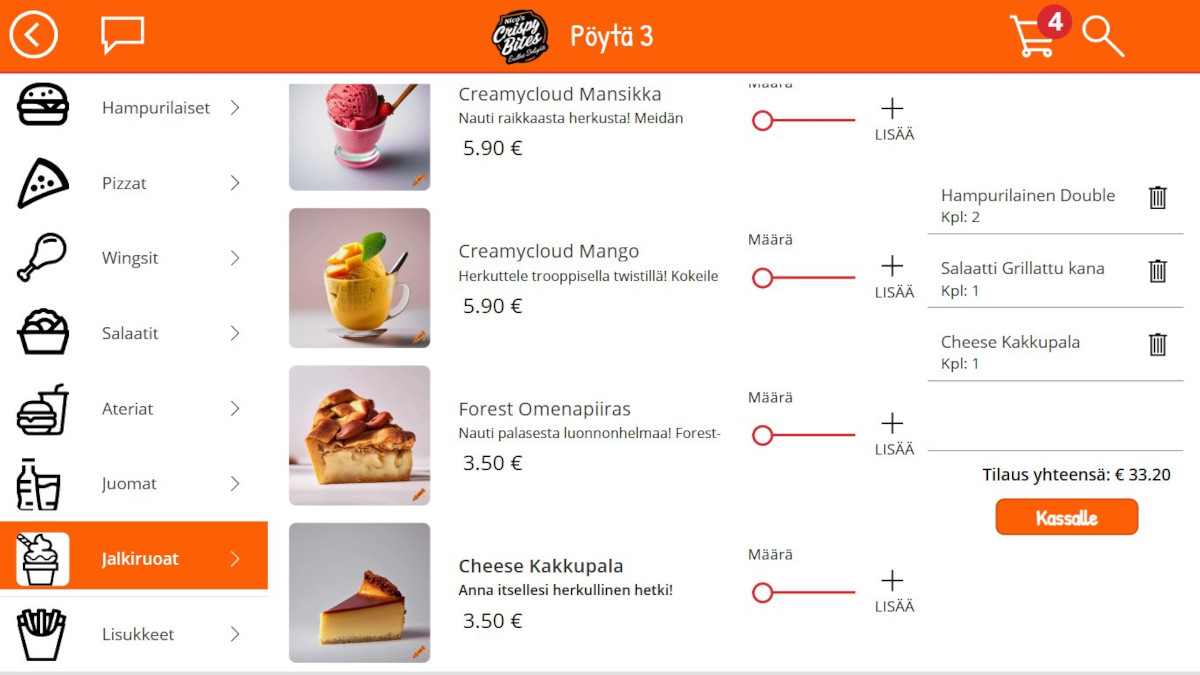
The customer interface operates on a shopping cart principle. Product data and attributes are retrieved from a SharePoint table, and the contents of the shopping cart are stored as a variable named “cart” within Power Apps. When a customer confirms an order, the order details are stored in another SharePoint table. The shopping cart is then cleared, and the order is sent to the kitchen and cashier staff for processing.
The final outcome of the project was a relatively simple yet highly reliable and user-friendly ordering system suitable for small businesses. One funny detail that I noticed afterward was that the IKEA Bistro café had introduced an ordering system almost identical to mine, down to the graphical layout. This confirms that the system is also practical for real-world use.